

Share This Article
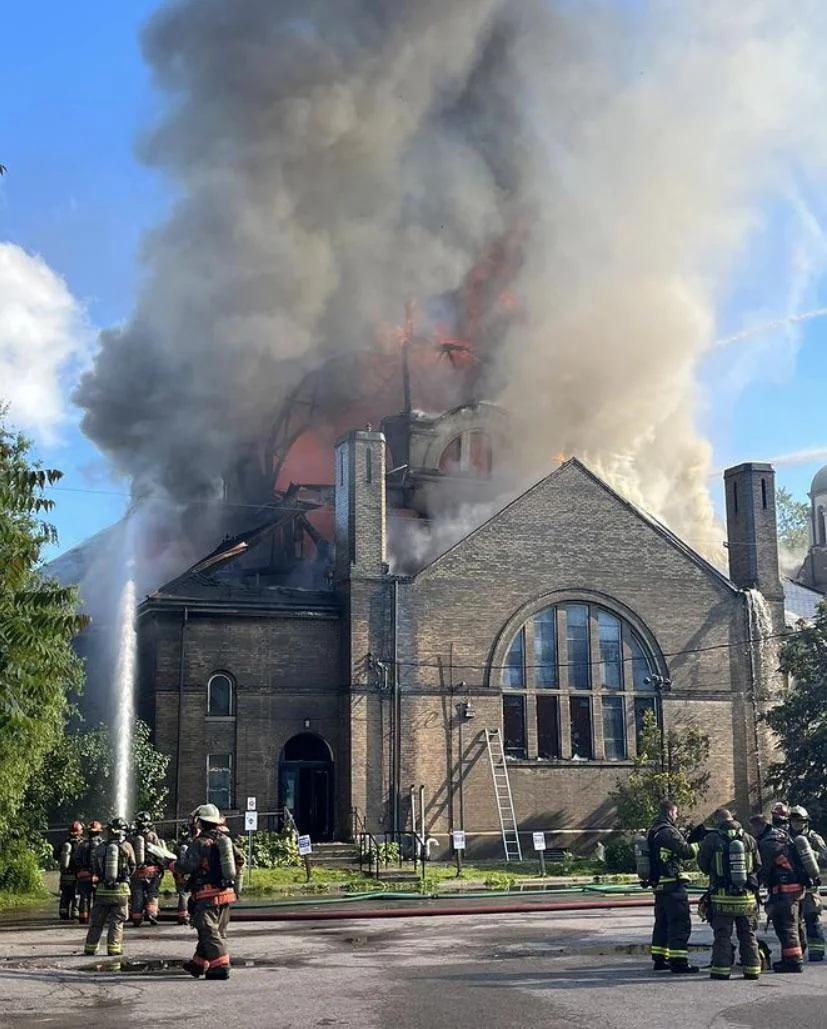
A new contemporary art exhibition is marking the reopening of St. Anne’s Anglican Church to the public following the devastating fire that significantly damaged the historic Toronto church in 2024.
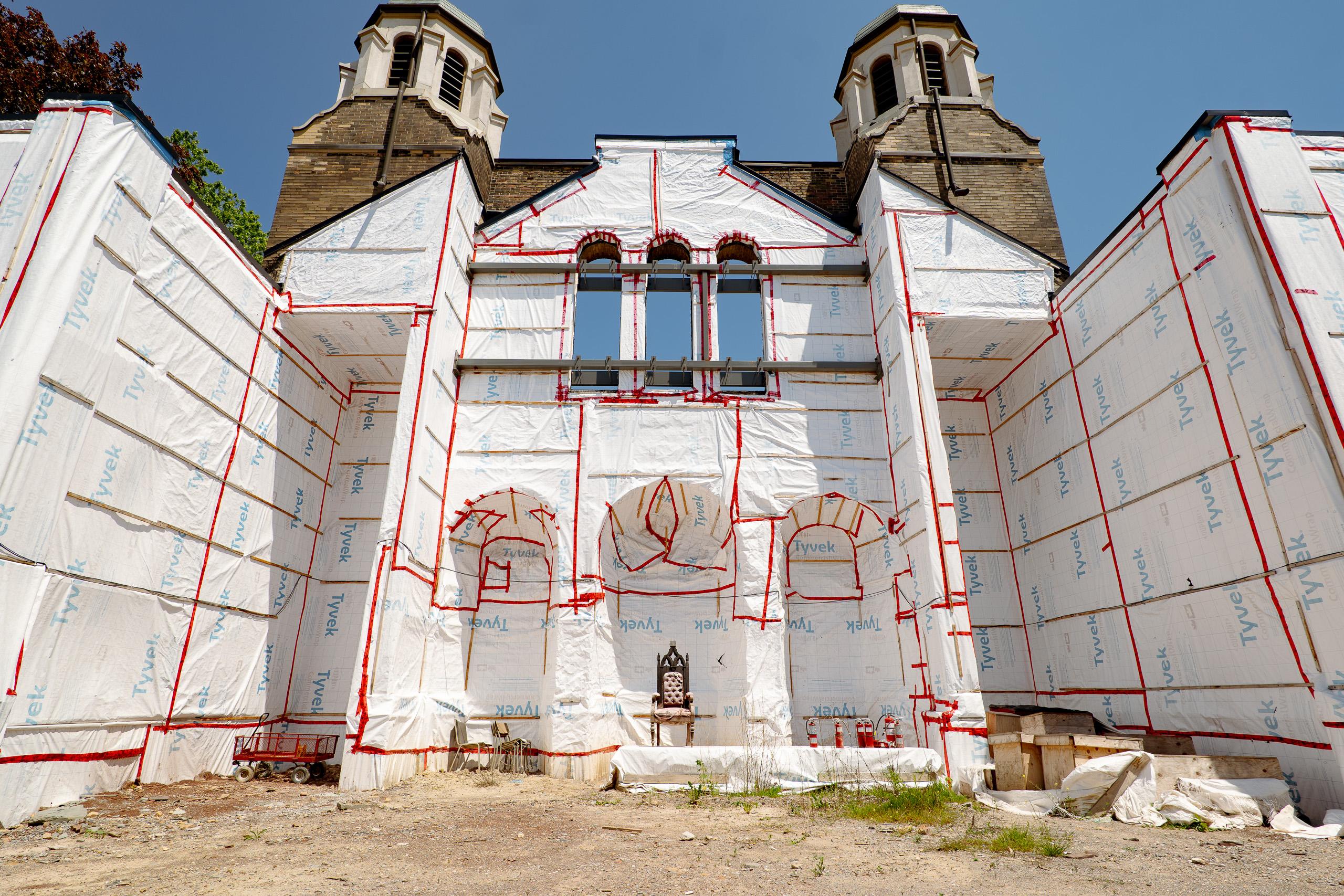
Where Walls Meet Sky brings together 12 Canadian artists working across sculpture, installation, photography, and multidisciplinary practices, presented within the remains of St. Anne’s, and explores themes of renewal, resilience, memory, transformation, and rebirth while inviting visitors to experience the church in an entirely new way.
The exhibition also marks the first time the church has reopened to the public in its current state since the 2024 fire.
For this edition of In Conversation, we spoke with exhibition curator Rui Pimenta and St. Anne’s Priest-in-Charge, Rev. Hannah Johnston, about how Where Walls Meet Sky came together, the impact of the fire on the church and its congregation, and what they hope visitors take away from the exhibition.
Editor’s Note: Responses have been edited for length and clarity.
Table of Contents
Conversation with Rui Pimenta

What inspired Where Walls Meet Sky, and why was St. Anne’s the right setting for this exhibition?
Rui: This project arose out of an invitation by St Anne’s Church for me to curate an art exhibition. As St. Anne’s has hosted art exhibitions and music concerts in the past, well before the fire, this felt like a significant opportunity to continue that legacy and also move beyond the deep feeling of loss.
How does the exhibition connect with St. Anne’s long artistic history?
Rui: St. Anne’s has a remarkable history of supporting the arts. Over the years, it has hosted art exhibitions, concerts, and other cultural events, while its historic murals by J. E. H. MacDonald and other artists associated with the Group of Seven are an important part of the church’s cultural legacy.
There is a real continuity here. Where Walls Meet Sky isn’t introducing art into a place without an artistic history; it is continuing a longstanding relationship between St. Anne’s, artists, and the broader community.
There is something particularly meaningful about the participating artists responding to the church at this moment of transformation.
How did you select the 12 participating artists, and what were you looking for in their work?
Rui: I wasn’t looking for artists to illustrate themes of fire, loss, or renewal simply. I wanted artists whose work could respond meaningfully to the site’s physical and emotional qualities, while also considering the works’ ability to withstand exposure to the natural elements.
The works engage with ideas of memory, transformation, absence, resilience, spirituality, materiality, and the passage between different states.
I was also interested in bringing together very different artistic approaches and materials. Some works respond directly to the architecture, while others are more associative or experiential.
What connects them is their ability to make us see this place differently and bring out qualities that might otherwise remain unseen.
What do you hope visitors take away after experiencing Where Walls Meet Sky?
Rui: Above all, I hope people leave with a sense of possibility and an understanding of the power of creativity in response to loss and destruction.
The fire was devastating, and there is no intention here to minimize that loss. But the exhibition asks us to consider what can emerge from destruction and what it means for a place to remain alive while undergoing profound change. Perhaps we are most alive when changing.
I also hope visitors experience St. Anne’s not simply as a damaged building, but as a place that is still capable of gathering people, generating ideas, and creating meaningful experiences.
The title Where Walls Meet Sky speaks to that idea: the walls remain, but they now open onto something beyond themselves. For me, that becomes a metaphor for the possibility of renewal, not returning to exactly what was, but imagining what might come next.
Conversation with Rev. Hannah Johnston
What does it mean to welcome the public back to St. Anne’s for the first time since the 2024 fire?
Rev. Hannah: Many of our parishioners are volunteering at the exhibition to welcome people from the neighbourhood and show visitors around.
It is a wonderful opportunity for people to meet members of the congregation and learn more about St. Anne’s and our community.
How has the congregation stayed connected and resilient since the fire?
Rev. Hannah: We have not missed a single week of worship. We continue to gather in the Parish Hall.
Since around spring this year, our congregation has started growing again, with new faces and families joining us. The last six months have been very positive.
The church building itself is still very much a ruin. There is no roof, and significant parts of the walls and floors were damaged. The congregation will continue worshipping in the Parish Hall until redevelopment takes place.
Why was it important for art to play a role in this stage of the church’s reopening?
Rev. Hannah: During my twenties and early thirties, I found myself moving between different career paths. I often felt torn between beauty, artistic and creative work, and trying to help people and bring good into the world.
For a long time, I worked with homelessness services and public housing in the U.K., while also being involved in fashion and creative spaces. I would often burn out in one and move to the other. It was only in the church that I found a place where creativity and justice could exist together.
I think that is one of the most important things the church has to offer, and it is something St. Anne’s does particularly well. We care about people and community, work for justice, serve people in need, and at the same time deeply value creativity, whether through music, visual art, or other forms of creative expression.
That has been part of St. Anne’s DNA for a very long time, and it was one of the things that first attracted me to the church when I became a member.
How are the restoration efforts progressing, and what work remains?
Rev. Hannah: The insurance payout was the maximum amount available, but of course it is impossible to insure priceless things such as historic works of art. There will always be a limit to what insurance can replace. The Diocese of Toronto is currently holding the funds for St. Anne’s, while we discern the next steps for the building.
We spent approximately nine months to a year stabilizing the building in its current state and working with heritage experts to determine what that process should look like, while making sure everything that remains is protected.
We have been told the building can survive in its current stabilized state for up to 10 years, which gives us time to develop a plan for the site’s future.
It will be a long-term project. We hope that plans can include opportunities such as affordable housing alongside the creation of a new church space that can serve both the present community and future generations.
How can the public support the church and its restoration efforts?
Rev. Hannah: Right now, we are not fundraising specifically for a new building. The most important thing right now is ensuring that the church community and congregation continue to survive and grow so we can invest in our future.
One of the best ways people can support us is by visiting the exhibition, getting to know the community, and engaging with what is happening here.
The exhibition is donation-based, so visitors can contribute while attending or support St. Anne’s online through CanadaHelps.
What do you hope visitors understand about St. Anne’s and its future after experiencing the exhibition?
Rev. Hannah: I haven’t yet seen all of the artists’ work because much of it is still being installed, but I think there is a powerful image here of rising from the ashes.
The fire that destroyed the church building is not the end of the church. It is not the end of the work this community is doing, and it is not the end of God’s work in the world.
There will also be opportunities for visitors to meet artists on site and reflect on questions around new life, resurrection, renewal, and what can emerge after loss.
A Church and Community Looking Forward
Through themes of renewal, resilience, memory, and rebirth, Where Walls Meet Sky reflects on how communities, ecosystems, and structures adapt and regenerate in the wake of upheaval.
But the exhibition is also about more than the art on display. By bringing visitors back inside St. Anne’s, it transforms the church’s remains into an active gathering place once again, one where art, community, spirituality, and questions about the future can coexist.
Where Walls Meet Sky opens at St. Anne’s Anglican Church, 1270 Gladstone Avenue, Toronto, on August 22, 2026.
Admission is free; donations are welcome.
As always, you can discover more arts, culture, exhibitions, and community stories shaping Toronto and the Greater Toronto Area on efosa
